About CDU
We design, develop, test, maintain, and grow high-performance applications across web, mobile, and wearable platforms, harnessing technology to enhance quality of life.
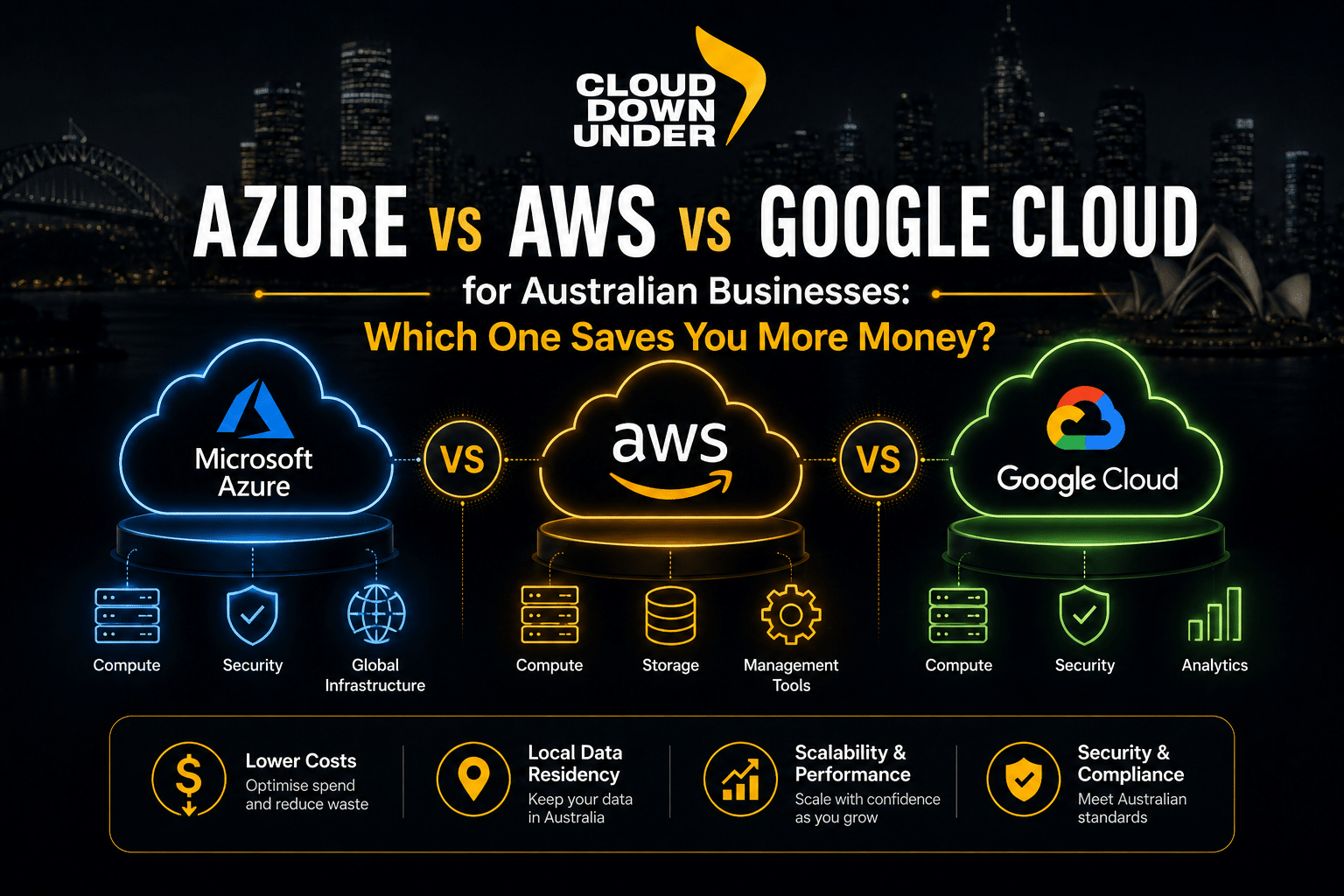
READ MORE ABOUT CDUCloud computing is no longer optional for businesses—it’s the backbone of modern operations. Here is an insight for Australian SMEs (Small and Medium Enterprises), choosing the right cloud provider which can significantly impact cost efficiency, scalability, security, and innovation.
In 2026, three major players dominate the cloud market:
- Amazon Web Services (AWS),
- Microsoft Azure, and
- Google Cloud Platform (GCP).
Together, they account for over 60% of global cloud usage, making them the top choices for businesses worldwide.
But which one is right for your business (AWS vs Azure vs Google)?
This guide breaks down AWS vs Azure vs Google Cloud specifically for Australian SMEs, helping you make an informed decision.
Why Cloud Choice Matters for Australian SMEs
Australian SMEs face unique challenges such as;
- Data sovereignty and compliance (e.g., Australian Privacy Act)
- Budget constraints
- Need for scalability as businesses grow
- Remote workforce and digital-first operations
Choosing the wrong cloud provider can lead to:
- Unexpected costs
- Performance issues
- Vendor lock-in
The right choice, however, can accelerate innovation and growth.
Here is an Overview of the Big Three which will help you make a right choice for your company.
1. Amazon Web Services (AWS)
AWS is the market leader, holding roughly 30–32% global market share. It is mainly because of the largest ranges of services offered by this platform besides the Mature ecosystem and global infrastructure and strong support for startups and scaling businesses.
Hence it is the best suit for:
- Startups and SaaS companies
- Businesses needing flexibility and scalability
2. Microsoft Azure
Azure is the second-largest cloud provider, with strong enterprise adoption. It is a power packed platform with seamless integration with Microsoft tools like Office 365, windows Server and very strong hybrid cloud capabilities. It is much popular especially for enterprise security and compliance.
It is best suited for:
- SMEs already using Microsoft products
- Businesses needing hybrid cloud setups
3. Google Cloud Platform (GCP)
Google Cloud is the fastest-growing cloud platform, known for innovation in AI and data. It is power packed with advanced analytics and machine learning tools with competitive and flexible pricing. It has a very strong global network performance.
It is best suited for:
- Data-driven businesses
- AI/ML-focused startups
AWS vs Azure vs Google Cloud: Feature Comparison in brief:
| Feature | AWS | Azure | Google Cloud |
| Market Position | #1 leader | #2 | #3 |
| Services | 250+ services | 200+ services | 200+ services |
| Pricing | Complex, pay-as-you-go | Moderate | Generally, most cost-effective |
| Strength | Flexibility & scale | Microsoft integration | AI & data analytics |
| Hybrid Cloud | Average | Excellent | Strong |
| Ease of Use | Moderate | Easier for Microsoft users | Developer-friendly |
Pricing Comparison (2026)
Pricing is one of the biggest concerns for SMEs.
- AWS: Flexible but complex pricing; discounts require long-term commitment
- Azure: Competitive pricing, especially for Microsoft customers
- Google Cloud: Often the most cost-efficient with per-second billing and automatic discounts
👉 For Australian SMEs:
Google Cloud is often the most budget-friendly, while AWS offers better scalability for growth.
Performance & Global Infrastructure
All three providers offer:
- High availability (99.9% uptime SLA)
- Global data centers
- Scalable infrastructure
However:
- AWS: Largest infrastructure footprint
- Azure: Most regions globally
- Google Cloud: Fastest network and strong data processing
For Australian businesses, local data centers in Sydney, Melbourne, and beyond ensure low latency and compliance.
Security & Compliance
Security is critical, especially with Australian regulations.
All three providers offer:
- Identity and access management (IAM)
- Data encryption
- Compliance certifications
Differences:
- Azure: Strongest for enterprise compliance
- AWS: Most mature security ecosystem
- Google Cloud: Advanced zero-trust security model
AI & Innovation in 2026
AI is driving cloud adoption globally.
Recent trends show:
- Cloud spending is rapidly increasing due to AI workloads
- Businesses are prioritizing AI-ready infrastructure
Comparison:
- AWS: Broad AI tools and infrastructure flexibility
- Azure: Strong AI integration with enterprise tools
- Google Cloud: Lead in AI/ML and data analytics
If your SME is planning AI adoption, Google Cloud or Azure may be better choices.
Real-World Use Cases for SMEs
Choose AWS if:
- You’re building a scalable SaaS platform
- You need maximum flexibility
- You plan to grow globally
Choose Azure if:
- You already use Microsoft tools
- You need hybrid cloud (on-prem + cloud)
- You want strong enterprise-grade security
Choose Google Cloud if:
- You rely heavily on data analytics
- You want cost efficiency
- You’re building AI-driven products
Multi-Cloud: A Growing Trend
In 2026, many SMEs are adopting multi-cloud strategies—using more than one provider.
Benefits:
- Avoid vendor lock-in
- Improve reliability
- Optimize costs
Major providers are even collaborating to support this trend, reflecting growing demand for flexibility.
Final Verdict: Which Cloud is Best for Australian SMEs?
There’s no one-size-fits-all answer.
- Best overall: AWS (for scalability and ecosystem)
- Best for Microsoft users: Azure
- Best for cost & AI: Google Cloud
Simple rule:
- Startup → AWS
- Enterprise SME → Azure
- Data-driven SME → Google Cloud
Conclusion
Choosing between AWS, Azure, and Google Cloud in 2026 comes down to your business goals, budget, and technical needs.
For Australian SMEs, the right cloud platform can:
- Reduce operational costs
- Improve agility
- Enable innovation
Considering the above criterion, Instead of asking “Which cloud is best?” it would be better to ask:
👉 Which cloud is best for my business use case?
See more Insights like this


With over 12+ years of experience we specialize in customized IT solutions for medium-sized businesses and corporations. Our priority is aligning with your goals, and we take pride in our work and clients.