About CDU
We design, develop, test, maintain, and grow high-performance applications across web, mobile, and wearable platforms, harnessing technology to enhance quality of life.
READ MORE ABOUT CDUYour developers push code. Your infrastructure team manages servers. And somewhere between those two worlds, releases break, deployments stall, and costly hours get burned fixing problems that should never have existed in the first place.
That gap — between development and operations — is exactly what DevOps consulting is designed to close.
For Australian businesses scaling on cloud infrastructure, the stakes have never been higher. Downtime costs money. Slow releases cost market share. And insecure deployments can cost far more than that. The good news? With the right DevOps consulting partner, all of this is solvable — and faster than most founders expect.
This guide breaks down what DevOps consulting actually delivers, why it matters specifically for Australian businesses in 2026, and what to look for when choosing a partner.
What Is DevOps Consulting — Really?
Let’s clear something up. DevOps is not just a tool, a job title, or a CI/CD pipeline. It’s a cultural and technical framework that aligns how your team builds software with how that software is deployed and maintained.
DevOps consulting brings in experienced specialists to assess your current development and deployment workflows, identify friction points, and implement automation and best practices that your internal team may not have the bandwidth — or specialisation — to build themselves.
Here’s the thing: most Australian startups and SMBs don’t have a dedicated DevOps engineer. They have developers who double as infrastructure managers. That hybrid arrangement works until it doesn’t — and when it fails, it tends to fail loudly.
A DevOps consultant steps in to do the structural work: design your CI/CD pipelines, implement Infrastructure as Code (IaC), define deployment standards, and set up monitoring and alerting. Then they hand you a system that your team can actually operate.
Why Australian Businesses Are Prioritising DevOps in 2026
The Australian cloud market has matured significantly. AWS, Microsoft Azure, and Google Cloud are now table stakes — not competitive advantages. What separates high-performing digital businesses from the rest is how they deploy and operate on those platforms.
A few shifts are driving the urgency in 2026:
Releases are faster, which means failures are also faster. Australian SaaS companies and digital platforms are under pressure to ship features quickly. But without structured DevOps practices, speed increases risk. A botched deployment at 2pm on a Friday is not a hypothetical — it’s a regular occurrence for teams without proper CI/CD workflows.
Cloud costs are spiralling. As Australian businesses scale on AWS or Azure, unoptimised infrastructure compounds quickly. DevOps consulting includes FinOps practices that embed cost visibility directly into deployment pipelines — so teams see the cost impact of changes before they hit production, not a month later on an invoice.
Security compliance is no longer optional. Australian privacy legislation (the Privacy Act and the Australian Government’s Essential Eight framework) is tightening. DevSecOps — the practice of embedding security checks directly into your CI/CD pipelines — is rapidly becoming the baseline expectation, not an advanced feature. In 2026, if your pipelines aren’t running automated security scans before code ships, you’re already behind.
The Core Components of a DevOps Consulting Engagement
Every business is different, but a solid DevOps consulting engagement typically covers four areas:
1. CI/CD Pipeline Design and Implementation
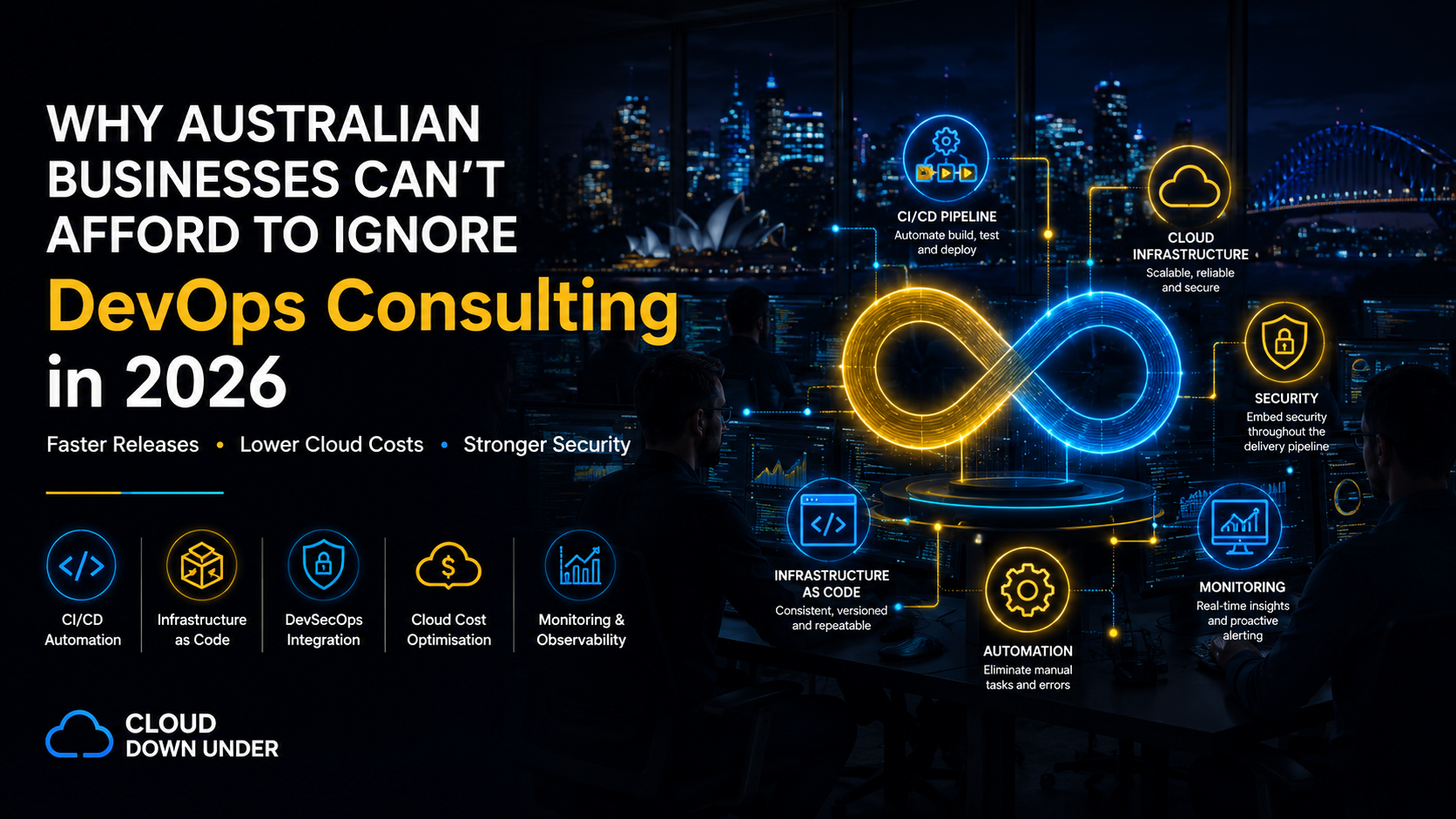
Continuous Integration and Continuous Delivery (CI/CD) pipelines automate the process of building, testing, and deploying your code. Rather than manually pushing releases, your team commits code and the pipeline handles the rest — running tests, checking for security vulnerabilities, and deploying to the right environment in the right sequence.
A good DevOps consultant doesn’t just set up a pipeline. They design one that fits your tech stack, your team’s workflow, and your risk tolerance. For an Australian SaaS business running on Microsoft Azure or AWS, this might involve Azure DevOps, GitHub Actions, or AWS CodePipeline — each with different trade-offs depending on your situation.
Cloud Downunder’s DevOps services include CI/CD implementation tailored to Microsoft and AWS environments — something that matters if your stack is primarily Azure-based.
2. Infrastructure as Code (IaC)
Think about it this way: if your infrastructure exists only as a set of manual configurations inside the cloud console, it’s essentially undocumented and unrepeatable. One team member leaves, and the knowledge walks out the door.
Infrastructure as Code solves this. Using tools like Terraform, Bicep, or AWS CloudFormation, your entire environment — servers, networking, security rules, databases — is defined in version-controlled code. Spin up a staging environment in minutes. Replicate production. Roll back changes cleanly.
For Australian businesses moving to or expanding on AWS, Terraform has become the industry standard. For Azure-heavy environments, Bicep is increasingly the tool of choice. A skilled DevOps consulting team will recommend the right fit rather than defaulting to whatever they know best.
3. DevSecOps Integration
Security used to be something added at the end of a release cycle. In 2026, that’s not viable. A DevSecOps approach embeds security into every stage of the pipeline — from code commit to production.
In practice, this means:
- Automated vulnerability scanning of application dependencies
- Container image security checks before deployment
- Secrets management (no hard-coded API keys or credentials in code)
- Compliance-as-code for Australian regulatory requirements
Organisations in regulated sectors — financial services, healthcare, government — benefit most from this. But honestly, any business handling customer data should be operating this way.
4. Monitoring, Observability, and Incident Response
Deploying cleanly is only half the equation. You also need to know when something goes wrong — ideally before your customers tell you.
Modern DevOps consulting includes setting up observability stacks: centralised logging, performance metrics, distributed tracing, and alerting. When something breaks in your production environment at 3am, your team gets a notification with context — not a generic alert and a mountain of logs to sift through.
In 2026, AI-powered observability tools (sometimes called AIOps) are becoming standard. These systems don’t just alert — they detect anomalies, correlate failures across services, and increasingly recommend or automate remediation.
DevOps vs Cloud Infrastructure Management: What’s the Difference?
This comes up constantly, so let’s settle it clearly.
Cloud Infrastructure Management is about the underlying platform. It covers provisioning servers, configuring networking, managing security policies, monitoring uptime, controlling costs, and ensuring the environment is stable and compliant. The goal is a secure, reliable, cost-effective foundation.
DevOps operates on top of that foundation. It’s about how your software gets built, tested, and deployed onto that infrastructure. The goal is faster, safer, more reliable software delivery.
They’re complementary — not competing. In a mature organisation, both functions work together. DevOps teams build on top of a well-managed cloud foundation. Without good infrastructure, DevOps practices become unstable. Without DevOps, good infrastructure is underutilised.
Many Australian businesses start with cloud infrastructure management (getting their AWS or Azure environment in order) and then layer DevOps practices on top. That sequencing generally works well.
What to Look for in a DevOps Consulting Partner in Australia
Not all consultants are equal. Here’s what actually separates useful partners from expensive ones:
Genuine cloud platform expertise. A consultant who can set up a generic Jenkins pipeline is not the same as one with deep Microsoft Azure or AWS expertise. Your cloud platform matters — choose a partner with verifiable experience on yours.
A practical, business-aware approach. The best DevOps consultants don’t just implement technology. They understand your release cadence, your team’s skill level, and your operational constraints. Advice that ignores those realities isn’t advice — it’s a liability.
End-to-end capability. You want a partner who can help with CI/CD design, IaC, security, monitoring, and ongoing support — not one who sets up pipelines and disappears. DevOps maturity is a journey, and you’ll want a team that can grow with you.
Local presence and availability. Time zone alignment matters more than it sounds. When you’re troubleshooting a production incident, a consultant in a compatible time zone is genuinely valuable. Australian-based teams — like those at Cloud Downunder — bring the added benefit of understanding local compliance frameworks and business context.
Evidence of results. Case studies, references, and measurable outcomes. What did deployments look like before and after? What did error rates do? How did release frequency change? Numbers matter.
The AIOps and Platform Engineering Shift: What’s Coming Next
The DevOps landscape is moving fast — and if you’re planning a consulting engagement now, it’s worth understanding where things are heading.
AIOps is the integration of AI and machine learning into DevOps operations. Rather than passively monitoring systems, AIOps tools actively learn from your system’s behaviour and surface predictions: “this service is trending toward saturation,” “this deployment pattern historically precedes failures.” The global AIOps market is on track to exceed $36 billion by 2030, and early adopters are already seeing meaningful reductions in incident response time.
Platform engineering is becoming the standard for scaling DevOps across larger teams. Instead of every developer managing their own pipeline configuration, platform engineering creates an internal “developer platform” — a standardised, self-service environment where teams can provision environments, deploy services, and monitor applications without needing deep DevOps expertise. Around 55% of global organisations have already adopted some form of platform engineering, with 71% of mature adopters reporting significantly faster time-to-market.
For Australian businesses right now, neither of these needs to be the starting point. But a good DevOps consulting partner will design your foundations in a way that makes adopting them straightforward — rather than requiring a full rebuild when you’re ready to scale.
How Cloud Downunder Approaches DevOps Consulting
At Cloud Downunder, we’ve spent over 12 years helping Australian businesses build and operate modern software platforms. Our work spans Microsoft Azure, AWS, DevOps automation, and cloud-native application development — covering the full journey from code to deployment to ongoing operations.
Our DevOps consulting approach is practical by design. We start with where you are: understanding your current release workflow, your infrastructure, your team’s capabilities, and your business constraints. From there, we design and implement DevOps practices that fit your context — not a templated solution built for a different kind of business.
Whether you need a CI/CD pipeline built from scratch, a DevSecOps upgrade to your existing setup, or Infrastructure as Code implemented across your Azure or AWS environment, we’ve done it before — for companies in healthcare, fintech, SaaS, and across a range of Australian industries.
Ready to talk? Book a free 30-minute consultation with our team. No obligations, no generic pitch — just an honest conversation about your situation and what’s possible.
Frequently Asked Questions
How much does DevOps consulting cost in Australia?
Costs vary significantly based on scope. A focused engagement — such as CI/CD pipeline implementation for a single application — typically ranges from $5,000–$20,000. Broader transformations covering IaC, DevSecOps, and monitoring across multiple environments can range higher. Most reputable consultants will provide a scoped proposal after an initial discovery conversation.
How long does a DevOps consulting engagement take?
Again, it depends on scope. A targeted pipeline implementation can be delivered in 2–4 weeks. A full DevOps transformation — covering CI/CD, IaC, security integration, and observability — typically runs 2–4 months for SMBs.
Do I need a large team to benefit from DevOps consulting?
No. Some of the highest-impact DevOps engagements happen with small teams of 3–8 developers. The point is to eliminate manual overhead and reduce deployment risk — both of which matter regardless of team size.
What cloud platforms does DevOps consulting cover?
A good DevOps consultant should be capable across AWS and Azure at minimum. The tools differ — AWS CodePipeline and Terraform versus Azure DevOps and Bicep — but the principles are the same. Make sure your consultant has demonstrable experience with your specific platform.
What’s the difference between DevOps consulting and DevOps as a service?
DevOps consulting typically involves a defined engagement: assess, design, implement, and hand off. DevOps as a service is an ongoing managed arrangement where your DevOps partner handles pipeline management, infrastructure automation, and operational support on an ongoing basis. Many businesses start with consulting and transition to a managed model as their needs evolve.
Cloud Downunder is a top-rated Microsoft and AWS consulting firm based in Brisbane, Australia. We help Australian businesses modernise, scale, and get more from their cloud investment. Talk to our team today.
See more Insights like this

With over 12+ years of experience we specialize in customized IT solutions for medium-sized businesses and corporations. Our priority is aligning with your goals, and we take pride in our work and clients.