About CDU
We design, develop, test, maintain, and grow high-performance applications across web, mobile, and wearable platforms, harnessing technology to enhance quality of life.
READ MORE ABOUT CDUIntroduction
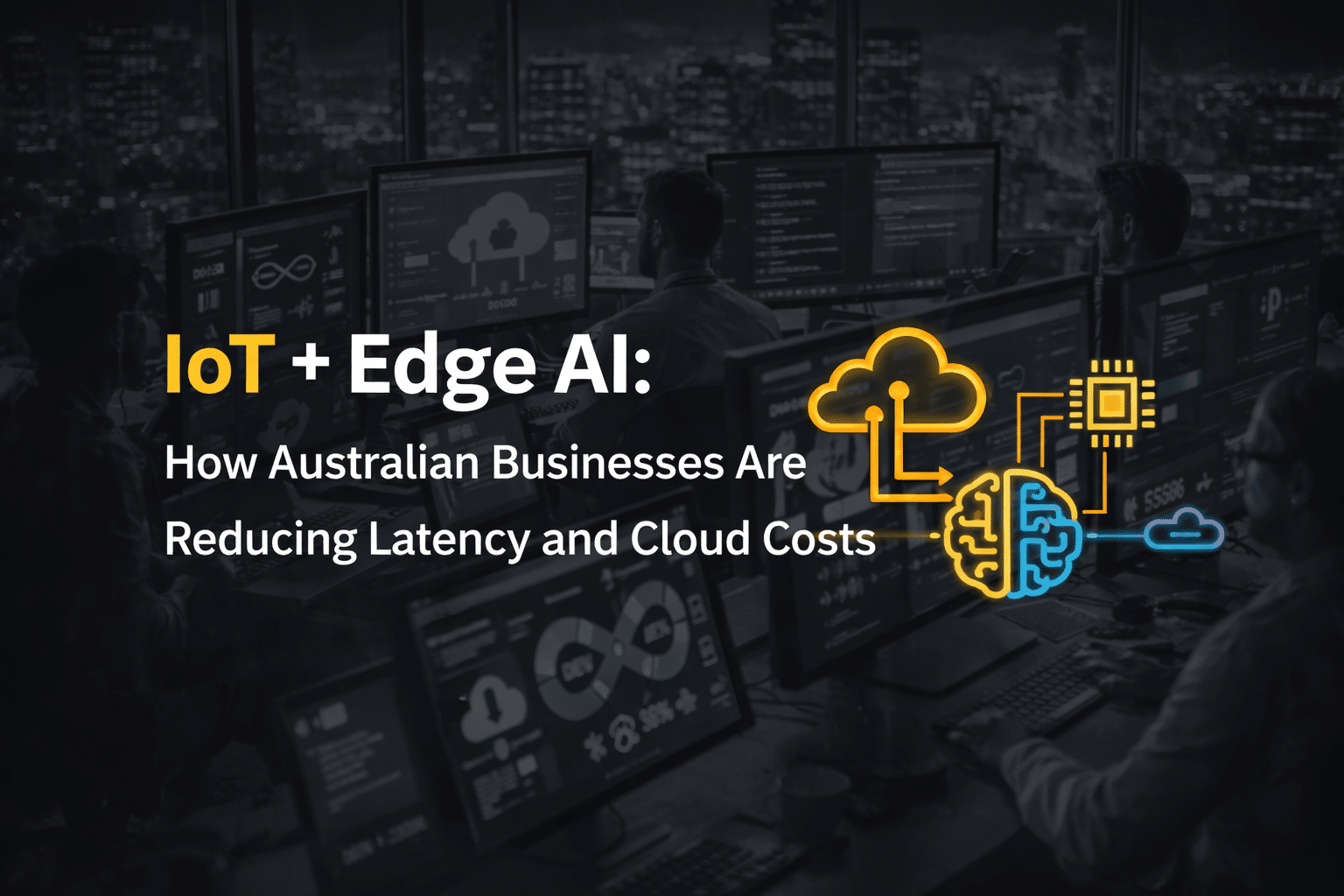
Every millisecond counts in modern Australian business operations. Whether you’re running a mine in the Pilbara, managing a smart building in Brisbane, or operating an NDIS healthcare facility in Melbourne, the ability to process data at the source — rather than routing it to a distant cloud server — is becoming a strategic advantage that separates high-performing organisations from the rest.
Welcome to the era of Edge AI and IoT convergence. In 2026, this combination is no longer a future concept; it is the operational baseline for forward-thinking Australian enterprises.
2026 marks the inflection point when IoT OEMs scale from early pilots to broad portfolio refreshes marketed as edge AI-enabled devices. The demand for local inference has been rising to improve latency, resilience, bandwidth efficiency, and privacy. (IoT Analytics, 2026)
What Is Edge AI, and Why Does It Matter for Australian Businesses?
Edge AI refers to the practice of running artificial intelligence models directly on or near the device that collects data — rather than sending that data to a centralised cloud server for processing. Think of it as giving your IoT sensors, cameras, and industrial machines their own brain.
Traditional IoT architecture sends everything to the cloud: sensor readings, video feeds, machine telemetry. This creates three costly problems:
- Latency: A decision that should take milliseconds takes seconds by the time data travels to the cloud, gets processed, and returns a response.
- Bandwidth costs: Transmitting raw data from thousands of devices continuously is expensive, particularly in remote Australian locations where connectivity is limited or costly.
- Privacy and sovereignty risk: Sensitive operational data crosses multiple networks and servers — a growing concern under Australia’s Privacy Act 1988 and the SOCI Act.
Edge AI solves all three. By running inference locally on the device or a nearby edge gateway, decisions happen in real time, bandwidth usage drops dramatically, and sensitive data stays on-premise.
The Current State of Edge AI Adoption in Australia
Australian businesses across sectors are actively piloting and deploying edge AI solutions. According to industry analysts, 2026 is the inflection year — we are seeing a rapid transition from pilot programmes to production-scale deployments.
Key drivers specific to Australia include:
- The government’s Future Made in Australia initiative ($22.7 billion) is incentivising industrial automation and IoT adoption, particularly for sustainability tracking and carbon reporting.
- Australia’s IoT sensors market is growing at 38% CAGR, among the fastest in the APAC region.
- AI, data governance, and edge infrastructure are the top two technology priorities for ANZ businesses in 2026, according to senior technology executives surveyed by iTnews.
- Microsoft’s 250% increase in Australian data centre capacity is creating a hybrid architecture opportunity: edge for real-time decisions, Azure cloud for analytics and long-term storage.
Industry Use Cases: Where Edge AI Is Winning in Australia
1. Mining and Resources
Australia’s mining sector is one of the most advanced adopters of edge AI globally. Predictive maintenance models deployed directly on drilling equipment flag failures before they happen. Autonomous haulage systems process visual and sensor data locally to navigate safely in real time. Safety systems no longer just report incidents — they actively intervene before harm occurs.
By 2030, AI and automation in Australian industry is expected to add $315 billion to GDP. The mining sector is already demonstrating what’s possible when edge intelligence meets heavy industry.
2. Precision Agriculture
Australia’s $60 billion agriculture industry is being transformed by IoT and edge computing. The Victorian Government alone invested $10 million in an IoT trial across 299 farm sites, deploying LoRaWAN connectivity and smart sensors for soil monitoring, livestock tracking, and smart irrigation.
Edge AI takes this further: instead of uploading gigabytes of soil and weather data to the cloud, smart sensors on-device can calculate exactly when to irrigate, how much fertiliser to apply, and when to harvest — saving:
- Up to 30% water usage through smart irrigation
- Up to 20% higher crop yields through precision decision-making
- Significant labour costs through automated machinery management
3. Smart Buildings and Facilities
Commercial real estate and property management firms are deploying edge AI to transform building operations. Smart HVAC systems that automatically adjust climate based on occupancy, AI-powered security cameras that process video locally without uploading footage, and energy management systems that cut consumption in real time — all without sending sensitive data off-site.
Smart buildings can reduce energy consumption by up to 35% by automatically adjusting lighting, heating, and cooling based on occupancy and weather conditions. (SaM Solutions, 2026)
4. Healthcare and Aged Care
In regulated sectors like healthcare, data sovereignty is non-negotiable. Edge AI enables real-time patient monitoring at the point of care — wearable sensors processing data locally rather than transmitting it over hospital networks, reducing both latency and privacy risk. For Australia’s growing aged care sector, this is transformative.
Technical Architecture: How Edge + Cloud Work Together
The best edge AI deployments in 2026 don’t replace the cloud — they complement it. The architecture typically works as:
- Edge devices and sensors: Capture raw data (temperature, vibration, video, audio).
- On-device inference: Lightweight AI models run locally, making immediate decisions (e.g., ‘this machine bearing is about to fail’).
- Edge gateway: Aggregates and pre-processes filtered data from multiple devices.
- Cloud platform (Azure/AWS/GCP): Receives summarised insights for long-term analytics, model retraining, and enterprise reporting.
This approach minimises bandwidth costs, maximises response speed, and keeps sensitive data sovereign — all critical requirements for Australian enterprises under the Privacy Act.
How Cloud Downunder Delivers Edge AI + IoT Solutions
At Cloud Downunder, our IoT and embedded development team specialises in designing edge AI architectures tailored to Australian industry requirements. From sensor selection and embedded firmware to cloud integration and real-time dashboards, we deliver end-to-end solutions that actually work in the field.
Our team has experience across:
- Industrial IoT and predictive maintenance systems
- Agricultural monitoring platforms with LoRaWAN and MQTT connectivity
- Healthcare and aged care monitoring applications
- Smart building energy management dashboards
- Custom edge AI model development and deployment
Getting Started: What Australian Businesses Should Do Now
- Identify your highest-latency, highest-bandwidth data flows and ask whether local processing could eliminate the delay and cost.
- Audit your data sovereignty obligations — particularly if you operate in healthcare, government, or critical infrastructure.
- Start with a proof-of-concept on one production line, one farm paddock, or one building floor before scaling.
- Choose an IoT development partner with embedded hardware experience — edge AI is not a pure software problem.
- Plan for over-the-air (OTA) firmware updates from day one — edge AI models improve over time and need to be updated at scale.
Conclusion
The era of shipping all your data to the cloud for processing is coming to an end. Australian businesses that deploy edge AI now will operate faster, cheaper, and more securely than competitors still relying on cloud-first architectures. The technology is ready, the use cases are proven, and the Australian government is actively funding the transition. Cloud Downunder helps Australian organisations design, build, and deploy edge AI and IoT solutions that deliver measurable ROI. Contact our team to discuss your specific requirements.
See more Insights like this
With over 12+ years of experience we specialize in customized IT solutions for medium-sized businesses and corporations. Our priority is aligning with your goals, and we take pride in our work and clients.